Some games you play with your thumbs. Others you play with your eyes. Evil Hunter Tycoon is the second kind, and I have spent more evenings with it than I would like to admit. You build a small town, heroes wander in, buy a sword from your shop, walk out to the hunting ground and fight. Most of the time you are not pressing anything. You are watching.
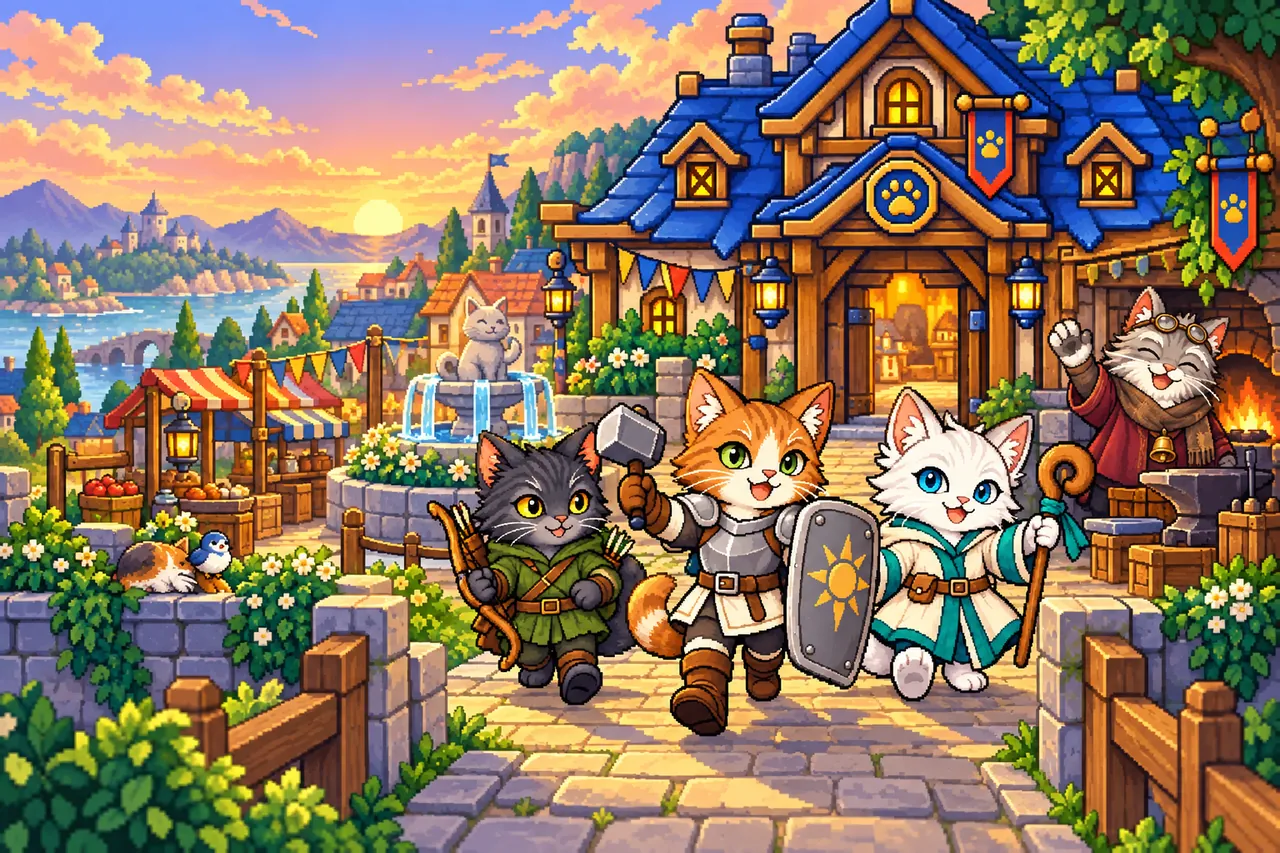
Paw & Sword is my attempt to build that kind of game again, with cat heroes, a much bigger roster and more reasons to keep watching. Before I write about individual systems in later devlogs, this post explains the thinking behind the whole thing: what I am copying on purpose, what I am making bigger, and the one rule every feature has to pass.
What Evil Hunter Tycoon got right
A lot of idle games are a spreadsheet with a nice skin. Numbers go up, you tap a button, numbers go up faster. Evil Hunter Tycoon felt different, and when I tried to pin down why, I ended up with four things.
- The town is not a menu. Heroes are tiny people with routines. They get hungry, sleep at the inn, shop, then walk out to hunt. Your buildings are places they use, so every upgrade shows up as a change in what you see on screen.
- Money loops back. Heroes earn gold in the field and spend it in your shops. You are not just collecting coins, you are running an economy of small, stubborn customers.
- The pace is kind. You can check in for five minutes, make two decisions and leave. Or you can sit and watch a boss fight for ten minutes because it is fun.
- Fights are readable at phone size. You can tell who is winning without reading a combat log.
None of these are flashy features. They are habits of design, and they are the part I want to keep almost unchanged.
What I want to make bigger
The parts I want to grow are the ones that ran out too early for me as a player.
The roster. Paw & Sword has 45 hero classes. Each class is one cat with its own look and personality, and that cat climbs through seven ranks, from Normal to Mythic, with a new outfit at every rank. The class list runs from familiar fantasy roles like a sword-and-shield tank, an archer and a fire mage to stranger ones like a Battle Chef or an Alchemist Duck (working names). I wrote a whole post on how one cat per class keeps 45 classes recognisable.
The world. The map is split into regions. Each region has hunting grounds, its own monsters and a field boss. Some of those bosses are deliberate walls that your town has to grow into. You summon them with a Boss Horn once your heroes have hunted enough in that region, and later there is a Raid Gate with bigger fights. Fame levels open new regions, so progress is something you earn by playing, not a timer you wait out.
The long game. Heroes can train, gear up through several equipment tiers and eventually go through the Rebirth Sanctum to come back stronger. That gives a hero you have used for weeks somewhere to go when they hit their ceiling.
The movement. Heroes walk and fight in eight directions instead of sliding sideways across the screen. It sounds like a detail. On a busy map it is the difference between a diorama and a living town.
Watching battles is the game
This is the rule every feature has to pass: does it make the game more fun to watch? If a feature only makes sense in a menu, it needs a very good reason to exist.
That rule has concrete consequences:
- Boss attacks are telegraphed. A big swing has a wind-up and a ring on the ground, so you can see trouble coming even if you cannot do anything about it.
- Arrivals and wins are events. A field boss gets a banner, a screen shake and its own music. A kill gets a victory screen that shows what everyone earned.
- Hero needs are visible. Every hero card shows health, stamina, hunger and mood. When a hero is not hunting, you can usually see why: they are eating, sleeping or limping home.
- Battle speed tops out at 2x, and 2x is free. I did not want a paid fast-forward, and at very high speeds the fights stop being readable, which defeats the point of the whole game.
What stays small on purpose
A big roster does not mean a big everything. Some decisions keep the project shippable for a one-person studio:
- Offline first. The core game plays fully offline on iPhone and Android. You should not need a connection to run your own town.
- English at launch. Other languages can come later, once the game is stable.
- No hero drama you cannot fix. Heroes never leave your town. If you neglect them they sulk and fight worse, but you will not lose a favourite cat. More on that in the post about rare heroes and why heroes never leave.
For the same reason, I check balance with automated bot players before a human ever sees a build. I wrote about that in balancing an idle tycoon with bot players.
Where it stands
Paw & Sword is in development for iOS and Android. There is no release date yet, and I would rather not guess one. What I can do is write honestly about how it is being built, including the parts that did not work the first time. That is what this devlog is for.