A party card looks simple: a sentence with a blank, or a short phrase. Writing hundreds of them that are still funny on the fiftieth game is a craft. This post is a look at how REZİL's cards are built: what a prompt has to do, the kinds of answers that win rounds, and how the two focus decks, expat life and office life, are put together.
A note before we start: REZİL is a 16+ game, but every example below is a clean one I wrote for this post to show the structure. None of them are real cards from the decks.
What a prompt card has to do
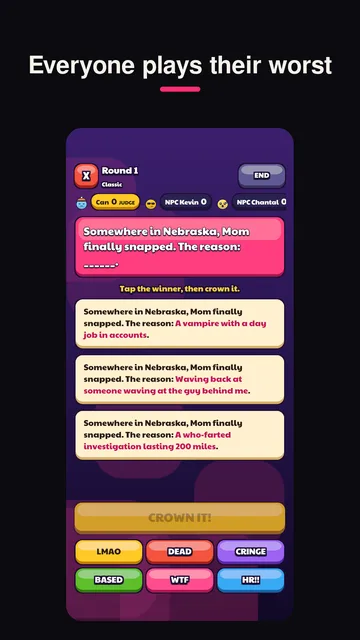
A prompt is a setup that the table finishes. That sounds obvious, but it rules out a lot of tempting cards.
- It has to fit many answers. If only one answer makes sense, the card is a crossword clue, not a prompt. A good prompt makes almost any answer in your hand sound like it might work.
- The blank belongs near the end. The punchline lands where the sentence ends. A blank at the start takes the surprise out.
- It must not be the joke. If the prompt is already funny on its own, the answers have to compete with it. The prompt should lean, not land.
- It has to read well aloud. Someone at the table will read it to everyone. Long setups lose people halfway through.
Two prompt shapes that work
Most strong prompts fall into one of two shapes.
Situation plus escalation. Start with something everyone recognises, then turn it, and let the blank finish the turn. For example: "The landlord finally fixed the heating. In return, he asked for ____." The first sentence sets a normal scene. The second promises a twist. The answer delivers it.
Short and sharp. A few words and a blank, where the answer does all the work. For example: "My secret talent: ____." These are the workhorses of a deck. They are almost impossible to ruin, and they make a strong answer shine.
A deck needs both. Escalation prompts create big moments. Short prompts keep the pace up between them.
Four kinds of answers that win
Answer cards are where most of the laughs come from. After a lot of drafts, the winners tend to belong to four families:
- Hyper-specific objects. Specific is funnier than general. "A photo" is nothing. "A laminated photocopy of my own passport" is a whole person.
- Familiar characters. Everyone knows someone like this: "the neighbour who knows everyone's business", "my aunt's family group chat". The table fills in the face.
- Absurd logic. Answers that make no sense in any context, so they make a strange kind of sense in every context. The in-game tutorial uses "a group project" and "a fire alarm" for a perfect first date, which is exactly this.
- Small dark confessions. Little admissions that everyone recognises and nobody says out loud: "pretending to be on mute", "reading the last page first". They get the laugh of recognition.
A good hand mixes all four, so whatever prompt appears, every player has something to try. That is why answer cards are written as short, self-contained phrases: they have to survive being dropped into any sentence.
The expat and office decks
Two focus decks exist because their audiences share a very specific kind of daily life.
Expat life (in Turkish, the gurbetçi deck) is about living between two countries: offices that want a form you can only get from another office, video calls where you explain your job to your grandmother again, and the suitcase that leaves empty and comes back full of food. An illustrative prompt: "At passport control they asked the purpose of my visit. I said: ____." An illustrative answer: "three kilos of homemade jam in my hand luggage".
Office life (in Turkish, beyaz yaka) is about meetings, inboxes and the strange theatre of being busy: "The meeting that could have been an email was actually about ____." Possible answers: "reply-all", "the printer on the third floor", "a calendar invite called 'quick sync'".
Both decks are written separately in each language, because the details of expat paperwork or office culture differ a lot between countries. I explain that approach in writing REZİL in 10 languages.
What gets cut
Editing matters as much as writing. Cards are cut when:
- the reference is obscure, so only some players get it;
- the card is only mean, with no wit behind it;
- it needs a picture or a tone of voice to work;
- in the Turkish deck, it is a religion joke, which is a deliberate line for that deck.
Wit comes first. The laugh should come from the combination the players chose, not from shock alone. How those combinations are judged and scored is in small rules, big laughs.