REZİL (on the App Store as "REZİL: Party Cards") is a party card game for ages 16 and up in the spirit of Cards Against Humanity. Everyone joins on their own phone with a room code, a prompt card with a blank appears, and players fill it with the funniest answer from their hand. It has cards in ten languages: English, Turkish, German, Dutch, Swedish, Norwegian, Danish, Finnish, Brazilian Portuguese and Hinglish.
None of those decks is a translation. Each one is written from scratch in its own language. This post explains why, and what actually changes from one language to the next.
Why translation kills party cards
A party card game is a joke-delivery machine. The prompt sets up an expectation, the answer breaks it, and the table laughs at the collision. Almost everything that makes that work is local.
- Rhythm. A punchline lands on the last word. Languages put their words in different orders, so a translated card often ends on the wrong word, and the laugh disappears.
- Wordplay. Puns and double meanings almost never survive translation. You can explain them, but an explained joke is a dead joke.
- References. The neighbour everyone has, the TV show everyone grew up with, the bureaucratic ritual everyone hates: these are different in every country.
- Register. How cheeky you can be, and how formal "normal" sounds, varies a lot. A line that is playful in one language can sound stiff or harsh in another.
A translated deck keeps the meaning and loses the punch. Players feel that immediately, even if they cannot say why.
What stays the same across languages
Writing ten decks from scratch would be chaos without a shared skeleton. The structure is common to every language:
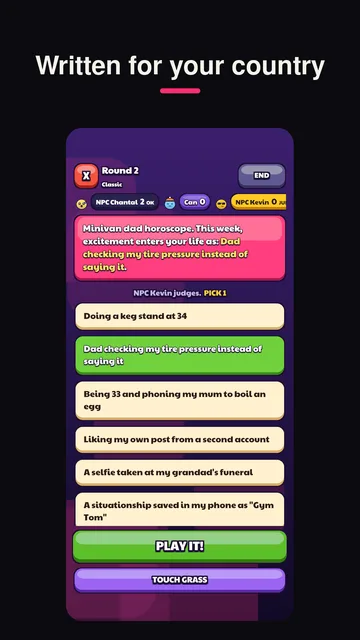
- The card formats: a prompt with one blank, a "Pick 2" prompt that takes two answers in order, and answer cards that work as short, self-contained phrases.
- The craft rules for what makes a prompt or answer funny, which I cover in detail in inside a REZİL deck.
- The table rules, the modes and the scoring, explained in small rules, big laughs.
- The tone: wit first. The laugh should come from the combination players choose, not from shock for its own sake.
What changes is the content: the situations, characters, objects and phrasing that make people in that language laugh.
What changes from one language to the next
Local decks. Each language has country-specific cards about the everyday things people there share: weather complaints, family habits, how people talk about money, the small rituals of daily life.
Focus decks. Two themes run across several languages, written separately each time. The expat deck (in Turkish, the gurbetçi deck) is about living between two countries: paperwork, phone calls with family, the suitcase that goes home empty and comes back full. The office deck (in Turkish, beyaz yaka) is about white-collar life: meetings, emails and the colleague who replies to everyone.
Length. Some languages simply need more letters to say the same thing. German and Finnish words can get long. Cards have to fit on a phone screen and be readable aloud, so each deck is written to its own length, not cut down from another.
Hinglish. Hinglish, the everyday mix of Hindi and English, shows the point clearly. It is a register in its own right. You could not translate a deck into it even if you wanted to; you can only write in it.
Rules that protect the table
A few rules apply to every deck, and some are specific to one language:
- Everyone at the table should get the reference. A card that needs a footnote does not belong in the deck. I would rather lose a clever niche joke than leave half the table out.
- No religion jokes in the Turkish cards. It is a deliberate line for that deck and its players.
- Text only. REZİL uses written cards with no explicit imagery, and it is made for players aged 16 and over.
- Menu language and card language are separate. Your menus can be in one language while the table plays a deck in another. The table should agree on a card language everyone understands.
The cost, and why it is worth it
Decks are not finished at launch either. New cards arrive in monthly drops, and players can suggest cards from the main menu. Suggestions are read with the same rules in mind, in the language they were written in.
Writing natively is slower than translating. Every language is its own small project, with its own good and bad first drafts. But the result is a game where a Turkish table and a Dutch table are both laughing at jokes written for them, not at the leftovers of someone else's.